longer than the stated benchmark
Among completed rollouts with a quantified estimate in the initial notice. “A few days” and “a few weeks” are excluded.
Examine the comparisons Technical SEOEvidence Protocol
The register · Google Search
Investigating a change? Find documented rollouts and ranking incidents around that date, across all families.
Read the periods
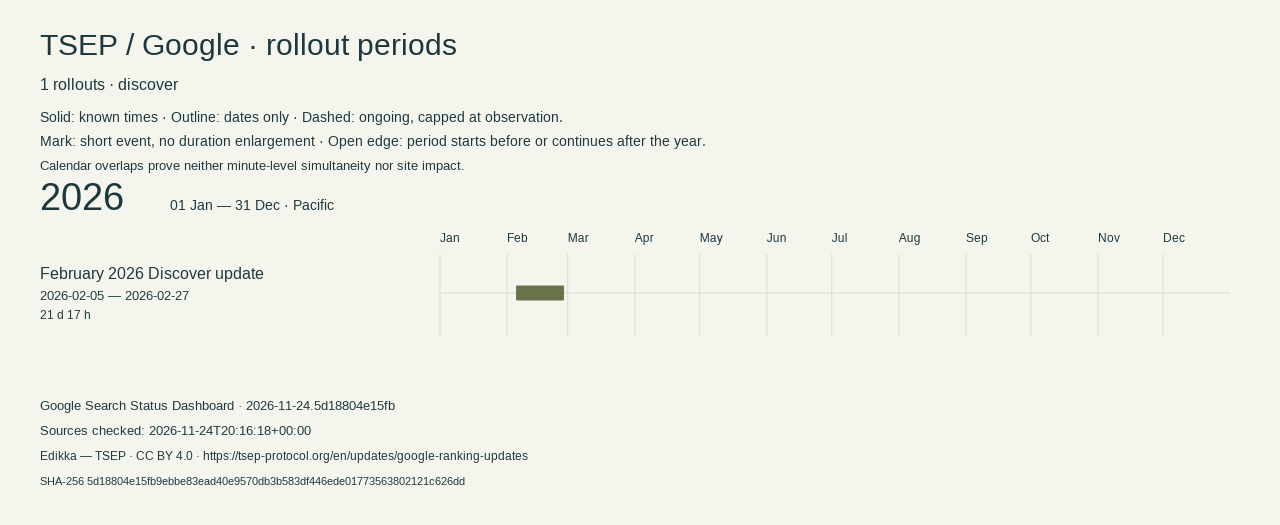
1 rollouts in this selection. One row per event, a shared annual scale.
Pacific calendar. Bars compare periods, not site impact. A vertical mark identifies very short events; periods spanning another year stay open at the scale’s edge.
Sources: Google Search Status Dashboard records retained in this collection. An open bar stops at the last observation: its end remains unknown. Date-only boundaries cannot establish minute-precise overlaps. Method and precision
No matching rollout. Try another year or reset the filters.
What Google’s records reveal
Calculations use the full collection, independently of filters. Every result remains linked to its dates and source.
Among completed rollouts with a quantified estimate in the initial notice. “A few days” and “a few weeks” are excluded.
Examine the comparisonsPublication times and declared completion times are distinct data. We preserve the discrepancy rather than guessing a correction to Google’s record.
On 2023-03-22, these initial notices were published after the launches they describe. A publication date is therefore not a start date.
An example on Google24 minute-precise durations and 16 calendar-date differences, for completed rollouts. They are not merged into one median. Midnight in an archive is not enough to establish an actual event time.
Read the methodA week means seven 24-hour periods when boundaries are precise; otherwise, we compare Pacific calendar dates. A month means the anniversary date in the following month, without converting it to 30 days. “About” estimates are not ceilings. An excess of a few minutes is counted without implying a contractual delay.
| Rollout | Announced | Observed | Interpretation |
|---|---|---|---|
| November 2026 core update | up to 2 weeks | 13 d 19 h 57 min | Within benchmarkMinute precision |
| September 2026 spam update | up to 2 weeks | 13 d 15 h 45 min | Within benchmarkMinute precision |
| May 2026 core update | up to 2 weeks | 11 d 21 h | Within benchmarkMinute precision |
| March 2026 core update | up to 2 weeks | 12 d 4 h | Within benchmarkMinute precision |
| February 2026 Discover update | up to 2 weeks | 21 d 17 h | BeyondMinute precision |
| December 2025 core update | up to 3 weeks | 18 d 1 h 35 min | Within benchmarkMinute precision |
| June 2025 core update | up to 3 weeks | 16 d 17 h 30 min | Within benchmarkMinute precision |
| March 2025 core update | up to 2 weeks | 13 d 20 h 35 min | Within benchmarkMinute precision |
| December 2024 spam update | up to 1 week | 7 d 2 h | BeyondMinute precision |
| December 2024 core update | up to 2 weeks | 6 d 3 h 30 min | Within benchmarkMinute precision |
| November 2024 core update | up to 2 weeks | 24 calendar days | BeyondCalendar dates |
| August 2024 core update | up to 1 month | 19 d 4 h 2 min | Within benchmarkCalendar dates |
| June 2024 spam update | up to 1 week | 7 d 59 min | BeyondMinute precision |
| March 2024 spam update | benchmark of 2 weeks | 14 d 21 h 6 min | BeyondMinute precision |
| March 2024 core update | up to 1 month | 44 d 23 h 58 min | BeyondCalendar dates |
| November 2023 core update | up to 2 weeks | 25 d 21 h 21 min | BeyondMinute precision |
| October 2023 core update | up to 2 weeks | 13 d 23 h | Within benchmarkMinute precision |
| September 2023 helpful content update | about 2 weeks | 13 d 10 h 48 min | Within benchmarkMinute precision |
| August 2023 core update | up to 2 weeks | 16 d 2 h 33 min | BeyondMinute precision |
| March 2023 core update | up to 2 weeks | 13 calendar days | Within benchmarkCalendar dates |
Median · from 0.8 to 45.0 days
Median · from 2.0 to 38.0 days
Calculated on the full collection on this page, independently of filters, averaging the two central values for even populations. Precision groups stay separate. Results are rounded to one decimal and do not predict the duration of a future rollout.
From date to diagnosis
Annotate the official period in your reporting. Separate the rollout, Google incidents and your own releases.
For a core update, Google advises waiting at least one week after completion, then comparing with a period before the rollout.
Inspect pages, queries and search types. Also check technical causes, seasonality and changes to the site.
Google core update guidance · Diagnose a traffic drop
TSEP helps document the technical observations below. These checks do not measure algorithmic impact or guarantee rankings.
Frequently asked questions
Use Google’s declared start and completion boundaries in Pacific time. The publication date of the launch or completion message is shown separately under “Source and dates”. It can differ; each record reports the observed difference.
Consult the referenceThe same instant can fall on different calendar dates across time zones. Minute-precise boundaries are available in Pacific time, UTC and Paris time. Where only a date is retained, we add no invented time or artificial conversion.
Consult the referenceNo. It is an initial estimate. Completion is retained when it appears in Google’s source. The comparison includes only completed rollouts with quantified estimates; vague wording is not converted into numbers.
Consult the referenceNo. Timing supports a hypothesis, not a causal conclusion. Compare pages, queries and search types, then examine incidents, site changes and seasonality. For core updates, Google recommends waiting at least a week after completion before analysing the change.
Consult the referenceNo. It retains rollouts documented by the official sources in this collection. Ranking incidents are separate, and unannounced changes are not invented. The family dossiers explain the systems and possible actions.
Consult the referenceThe scope
These two Ranking entries are service incidents. They remain available here but are excluded from the rollout count.
2024-08-15 17:15 PDT · Pacific — 2024-08-20 04:30 PDT · Pacific
Official Google source · Ranking is experiencing an ongoing issue.First retained notice : .
5 h 33 min after the declared start.
Launch scope: Scope not specified in the retained initial notice.
Understand dates and durations
6e128b0dd6d0…Captured on 2023-10-05 · time unspecified · Pacific — 2023-10-31 · time unspecified · Pacific
Official Google source · Ranking is experiencing an ongoing issueFirst retained notice : .
27 days after the declared start (calendar difference, no assumed time).
Launch scope: Scope not specified in the retained initial notice.
Understand dates and durations
3deb5a768a1f…Captured on Method and review
Sources last checked
The main date follows the official Pacific calendar (America/Los_Angeles), matching daily Search Console data. Details also show UTC and Paris when the source specifies a time. No time is added to date-only boundaries. Search Console’s 24-hour view instead uses local time. Search Console time zones
This register covers rollouts announced in the Ranking section of the Google Search Status Dashboard, from November 2021 onward. It does not cover every algorithm change or unconfirmed fluctuation. Previously captured rollouts are retained if they leave Google’s index.
Boundaries come from each official incident record, not from the publication time of its completion message. Precise times are converted from Pacific time to UTC with daylight saving handled. A midnight boundary is conservatively retained as a date only; its original value remains in the JSON.
An exact duration is calculated only when both times are known. Otherwise we show the difference between Pacific calendar dates: it is neither an exact duration nor an inclusive count of affected days. French titles and update families are TSEP editorial classifications; the original Google title is retained.
Captures contain the received bytes compressed with gzip; SHA-256 applies to the decompressed document. Capture dates are later than announcements: they do not prove that the document existed on the rollout date.
Source verification and register edition are separate dates. Reading guidance is AI-assisted; no human signature is created without an attestation for this exact version. Coincident dates establish neither the cause of a traffic drop nor website conformity.
Human review of this edition: pending.
AI-assisted presentation and additions; human review of this new edition is pending. The source-compilation signature and enriched-data hash cover different scopes, documented in JSON.
6b06c7882a23…6e9d069ff68e…7f2beb1f52a8…Independent timestamp
The historical token covers only captures listed in its manifest. Updates from collection have their own captures and dates.
44 captures bound to the manifest signed on .
Download the verification bundleThe timestamp proves that the captures existed no later than the signed time. It does not certify publication dates, content or human review. The ZIP contains the manifest, signed token and OpenSSL verification command.
2026-11-15.3 · Corrected notice scopes, calculated publication offsets, compared stated estimates with boundaries, unified dates and loaded views on demand. Human review of this edition is pending.
2026-11-15.2 · Annual timeline, date lookup, enriched exports and separation of rollout completion from completion-notice publication.
2026-11-06.1 · New reading by year and update family, search, FR/EN titles, separate incidents, CSV and Markdown exports. All 39 periods were rechecked without changes. Capture times, source values, method and timestamp verification bundle added.
2026-11-05 · Previous edition: 39 rollouts and their Google captures. Precise times distinguished from date-only boundaries.
Open data
A stable reference. The data in the format that fits your work.
CC BY 4.0The reference to cite
Edikka — TSEP. « Google ranking update history ». Edition 2026-11-24.a0e8420cb5a4. https://tsep-protocol.org/en/updates/google-ranking-updates. CC BY 4.0.
The ICS calendar contains all-day markers using Pacific dates. “TSEP analysis” markers are a working template, not a Google announcement. The CSV provides annotation text of at most 120 characters to copy into Search Console; it is not an automatic import. Add an annotation
Exports retain Google identifiers, date precision, complete hashes and evidence links. CSV covers rollouts; JSON and Markdown also include the separate incidents.
TSEP factual compilation and editorial classifications. Source documents retain their original terms.